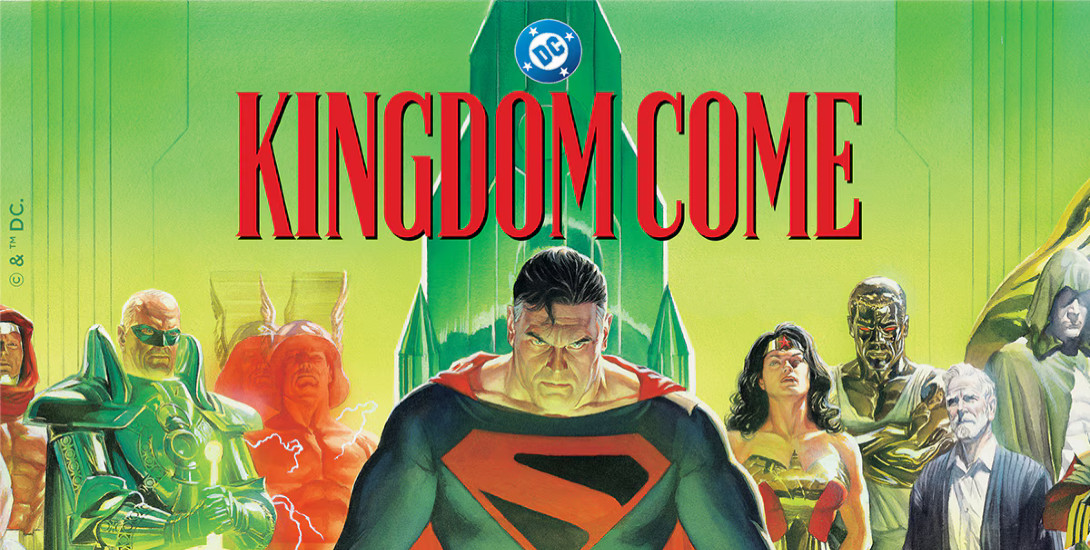
On a whim, I picked up Kingdom Come again on January 20th, 2026, expecting to find what I usually do: a few gems of wisdom, some eerily poignant details to lay out and marvel at, and perhaps a bit of nostalgia. I expected to find comfort in a story I’ve visited before; no different from when I last read this book in 2017, no different from any book I’ve revisited with a snappy op-ed in mind. While the world outside becomes more unpredictable, folding back into the arms of a narrative that has always held so much meaning for me felt like coming home, or, I thought it would. What I found instead was an unexpectedly difficult experience that left me pacing the floor late into the night, fluctuating between tearing up and settling into that thousand yard stare of frustration which seems to have become my default setting of late. I’ll warn you now, before I go further, that this series of essays is going to be political. There’s no way around it, and I don’t want to go around it. If you think I might piss you off, you can stop here. The words that follow will likely do nothing but ruin your afternoon and raise your blood pressure, and I don’t want that for you. Truly. Things are complicated enough without being infuriated by some comic book editorial writer who doesn’t understand your world view and probably will not read your comments. What is it the kids say? Touch grass? Do that. Close the page, go touch grass. Kingdom Came and Kingdom Went. For those of you at least willing to consider the impact of power and powerlessness on human dignity and safety, welcome.
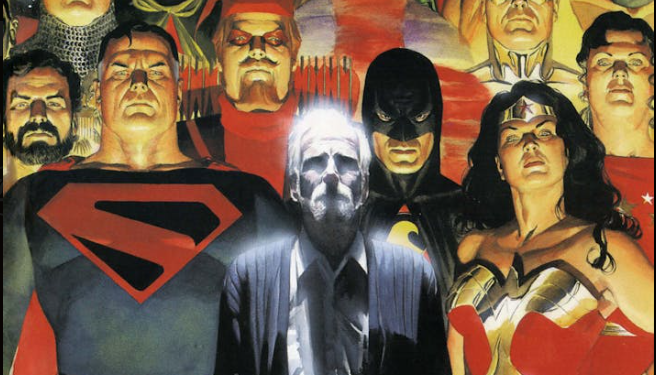
“We have an obligation to understand the ramifications of the things we do, and choose to do them – or not- with our eyes open. That is what Kingdom Come is about.” – Elliot S. Maggin (Introduction to Kingdom Come 20th Anniversary Edition)
I’m here to analyze a piece of art, to ask the questions a story like Kingdom Come raises, and to seek out truth in a work of fiction. The first truth is this: there is no such thing as unprecedented times to a comics reader. We’ve seen it all play out over and over again in a hundred different ways. We’ve seen a shady businessman with a bone to pick against an undocumented alien become the President of the United States. We’ve seen billion dollar corporations push humanity to the brink of extinction, and robots rival humanity’s value. We’ve seen the government rip families apart and label moms, dads, brothers, sisters, daughters, and sons as threats worthy of lethal force. We’ve seen the strong fail to protect the weak. We’ve seen villains cloak themselves in the regalia of heroes and pretend for all the world that they’re fighting the good fight. We’ve seen our heroes step down, betray us, and fail. We’ve seen the courage it takes to rise from the ashes, and we’ve seen that courage get good people killed.
We love these books that break our hearts. We see value in watching the great “what ifs” of the world play out because they give us the opportunity to take the ride, learn the lessons, and ultimately step off, back into our comparatively ordinary lives. The problem is, when I closed the book this time, I never had that sensation of stepping off the ride. I read scenes of Superman choosing to turn his back on the world while watching my country threaten long held alliances. I watched those entrusted to protect the public act with reckless violence on the page and on the news. Writing is what I do. Comics are what I do. I’m sharing this journey not out of spite or some foolish attempt at finger wagging, but because these questions have been asked before and must be asked again; because I love my country, and you cannot heal a loved one’s wounds by pretending they do not exist. There is no Superman coming to save us, but perhaps in taking the ride together, in a make believe world full of make believe dangers, we’ll find a common tongue. Maybe not. But if this is what I can do for the moment, I am obliged to do it.
Background
Mark Waid and Alex Ross created Kingdom Come in 1996 for DC’s Elseworlds imprint. Elseworlds books are a treasure trove of groundbreaking re-imaginings set apart from canon DC lore. What if Batman hunted Jack the Ripper? What if Superman landed in Soviet Russia instead of Kansas? The imprint is iconic for allowing creative teams to toy with the mechanics of the DC Universe and fully explore these questions to fruition.
If you’re a longtime comics reader, I probably don’t need to tell you what an absolute gift to humanity Alex Ross’s work is. Imagine the high-detail Americana of Norman Rockwell with a darker, grittier edge. But perhaps that doesn’t do it justice. The Norman Rockwell comparison is a bit played out. Instead, I’ll put it this way: imagine seeing every panel of a comic drawn with such realistic brilliance that it ought to be hung in an art museum. Every panel. Every time. No weak links. It’s almost as if when you pay a human being to create something, they create more than just the art, but a statement of human achievement, a sense of pride, of hope. I’ll get off that particular soapbox for now, but no AI is going to “throw on a leotard” to take reference pictures in the interest of giving you beautiful art. Alex Ross does that, and he deserves a medal of honor for it.
Mark Waid hardly needs introduction. He is a writer so in tune with the soul and psyche of our superheroes that he intuits their actions onto the page with pin-sharp clarity. We know they’re not real, but written by Mark Waid, for a moment, they are as real as you or I. He knows their hopes, fears, strengths, and weaknesses. He knows the choices they struggle with, the internal turmoil that shapes each decision, and the unspoken values that define how they move through conflict and triumph. The worlds he shapes around his characters cut through the noise and expectation, drawing forth reality – brutal, and bitter, and honest. Combined, Ross and Waid are a team capable of painting truth with shades of the impossible, and works compiled by such gifted minds cannot help but continue to give, even three decades after publication.
Chapter 1 Breakdown

The image is hazy; not dreamlike, but nightmarish. It’s a vision. In a blur of blood red and coal black, a bald eagle with a gash of stars and stripes across its wing clutches an arrow in its talon and dives at a screeching bat. Words from the Book of Revelation dot the page. Next, a sea of red. A hand grasps a lightning bolt from the steaming depths while a greenish-yellow mob of heroes battle in the distance. Again, the book of revelation – angels and voices, and woe.
These visions belong to an aging man in a hospital bed, Wesley Dobbs. He rants and raves at his pastor, Norman McCay, who gently, and with no small amount of exasperation, tries to minister to the frantic elder. He thinks Wesley is losing his mind. Wesley thinks Norman is blind to the truth that stands right in front of them. He is dead before he can make the pastor understand.
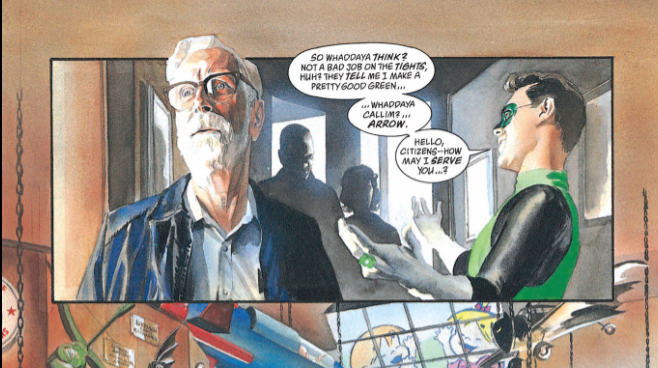
As Wesley’s casket is lowered into the earth, Norman presides over a small service. It’s a sad occasion with few mourners. In fact, Wesley and his wife were among Norman’s last friends. The man they now lay to rest is a far cry from what he once was, back in the “glory days” Norman says he spoke of often. Years ago, Wesley was a superhero. As Norman leaves the service, we begin to understand that such a title no longer means what it did before. We see a newspaper headline announcing more metahuman censures enacted by the U.N.. as Norman strolls the city streets, he passes crowds of onlookers going about their day, concrete walls scrawled with graffiti, and what appears to be a spaceship or some other vessel crashed into a building surrounded by police barriers. The strange scene hardly warrants a reaction. Instead, he continues to think about Wesley, remarking how the elder bemoaned “the passing of things like Olympic Games and Nobel Prizes.” In their world, so called “metahumans” have become so common that ordinary people no longer strive for achievement. Olympic Games and Nobel Prizes have been stripped of their worth and phased out.
According to Norman, Wesley believed that the heroes of his generation “inspired human achievement… not belittled it.” There is a new generation, and from the headlines, graffiti, and small background details, it appears this younger generation of heroes has strayed far from the footsteps of those who came before them. Still, Norman’s world is not without inklings of heroes gone by. He looks on at a restaurant called Planet Krypton, where the waitstaff are bedecked in cheap Halloween versions of Wonder Woman, Flash, Aquaman, Green Lantern, and Superman’s regalia. A customer orders something called “an American Way on white.” The page stinks of rampant and meaningless commercialism. These things that once held sacred resonance are now products to be sold and costumes to be worn for a quick buck. It gives the sense that there is nostalgia for the old days, but these cheap recreations bear no meaning and hold no power. The American Way is nothing more than lunch served on white bread- overplayed, overstated, and so detached from whatever it once was that it might as well be a Big Mac.
As Norman continues past Planet Krypton, reflecting on his need to “keep the faith,” we finally get a glimpse of these new heroes. A group of metahumans engages a robotic villain in the middle of the street. What looks to be a city bus flies overhead. Energy beams and explosions are flung with abandon. Bystanders jump from their cars and flee storefronts, running for cover. Not one of the heroes pauses to help them to safety. They’re too busy firing in the general direction of what we have to assume was some sort of threat. Instead, it is Norman who throws himself between an incoming blast and a little girl, knocking her out of the way. It is Norman who remembers that the point of chasing down villains is to save lives, not put more in danger; to quell chaos, not create it. The little girl Norman saved looks up, tears streaming from her eyes behind Norman’s words:
“They move freely through the streets… through the world. They are challenged, but unopposed. They are, after all… our protectors.”
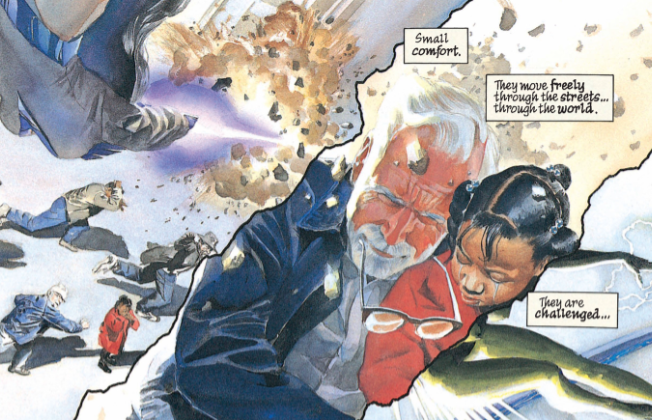
Norman tries to be positive, to hold faith that the world will someday belong to ordinary people again; that these beings with such unfathomable power to shape their lives will one day return to the service of keeping them safe. Before the page concludes, he admits that he is wrong.
In the days that follow, Norman struggles to preach to his congregation. These grim reflections are having an impact on his words, and he feels that he is failing the parishioners who come to him for hope. As he sits in a pew, dejected and disappointed in himself, The Spectre appears. Norman cannot decide if this is divine intervention or proof that he has gone as crazy as Wesley, but The Spectre clarifies that neither is true. Wesley was not crazy, and he is not an angel, at least in a traditional sense; though he does say that a higher power has sent him to punish those responsible for the “coming evil.” In Wesley’s absence, it is Norman who will bear witness. It is Norman who will judge.
The Spectre first takes Norman to what appears to be a farm. He assures him that while they can see and hear everything that happens on their journey, the individuals they observe can neither see nor hear them. A muscular man with graying black hair tied in a ponytail flies a plank of wood up to the roof of his barn. Superman. Or, he used to be Superman. Clark, who now goes by Kal, hung up his cape a decade ago after an incident which has not yet been explained. As he hoists a tractor up with one arm, a statuesque woman appears behind him. It has been a long time since Kal and Diana have spoken, and we get the impression that she is one of the only people who has spoken to him since the apparent death of his parents and wife, Lois Lane. She tells him that he cannot live forever in solitude. The past is gone, but the world needs him. Without Superman, the other members of the Justice League simply fell apart.
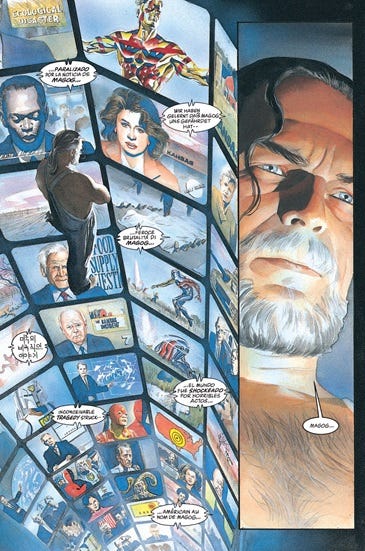
Wonder Woman is insistent, and it is revealed that what looked like the Kent family farm is really only a simulation being run (presumably) by the Fortress of Solitude. She finally convinces Clark to turn on the news, and there we see the first glimpse of the impending evil The Spectre spoke of. Magog, the shockingly violent “hero” who successfully chased Superman from the public eye, has inadvertently caused a nuclear event with mass casualties. He and his team, including Captain Atom, chased a villain known as Parasite into the wheat fields of Kansas. Parasite surrendered, but the beating continued. Parasite begged for mercy, and his cries fell on deaf ears. In a moment of panic, he fought back, and split Captain Atom open. The resulting explosion wiped Kansas and all who lived there, as well as much of Magog’s team, off the map. Clark turns off the news and tells Diana to go back to her island. He reminds her that he tried to warn them ten years ago, and no one listened.
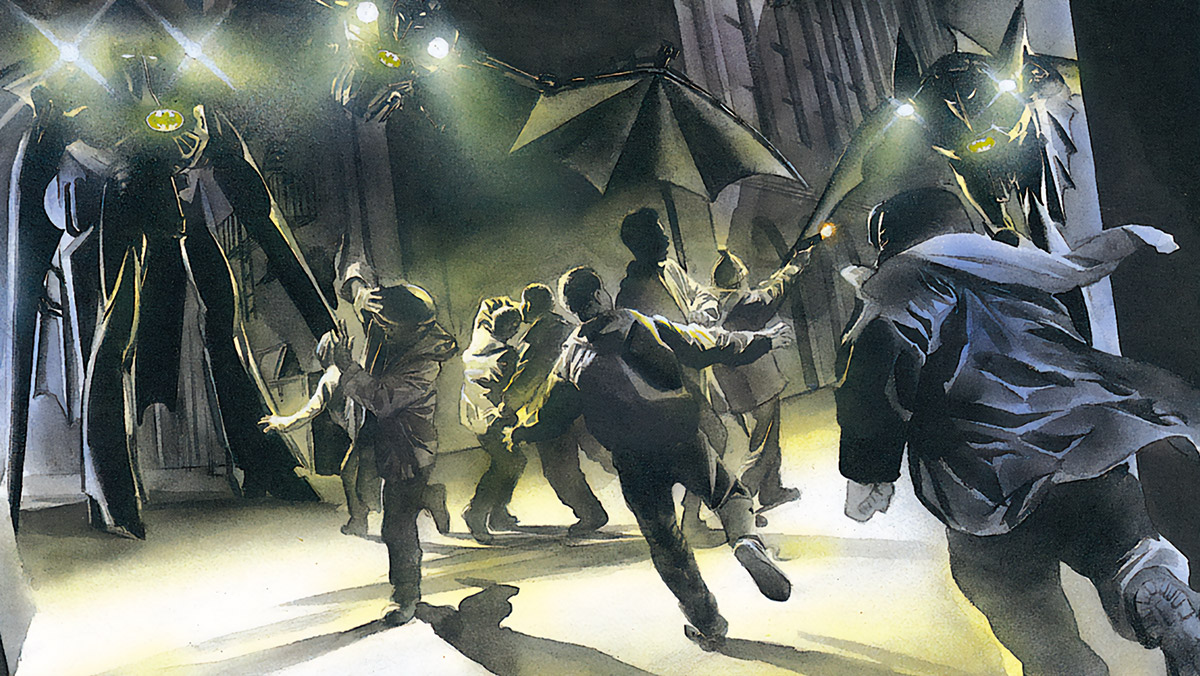
The Spectre shows Norman glimpses of what became of the rest of the Justice League. The Flash continues to fight crime, but invisible – always moving too fast to be seen. Green Lantern remains in watchful orbit around the earth ready to take on extraterrestrial threats, but does not involve himself in the day to day violence of earthlings. Hawkman patrols the Pacific Northwest, where some call him a hero, and others call him an environmental terrorist. And Batman? We witness a group of young teens brandishing a gun and running away from a fallen body, a purse clutched in one of their arms. Suddenly, they are surrounded by a swarm of large, dark robots with menacing bat ears. We get the sense that things are not going well in Gotham, though The Spectre says, perhaps ominously, that Batman has his city under control.
Finally, we move to Norman and The Spectre’s final stop for the day. A group of metahumans battle on a bridge. Once again, innocent bystanders are caught in the crosshairs, especially the unfortunate group trapped in the cable car they are fighting on top of. The cable snaps and the car begins to plummet. Norman screams to the sky “WE NEED HOPE!” Then, suddenly, someone shouts, “Look!” “Up in the sky!”
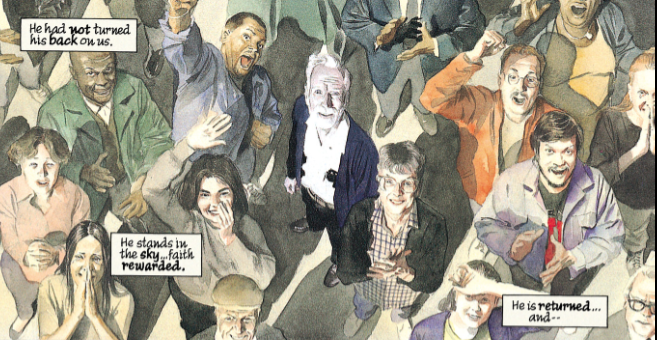
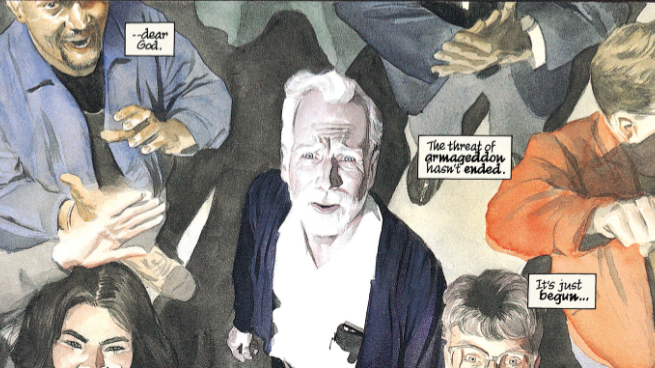
I must admit that when I read those lines, I felt genuine joy. The chaos and carnage pulls us in so effectively that, as a reader, the scene felt suffocating. That is, until the civilians cast their eyes skyward. Superman emerges, having saved the cable car, with one villain dangling from his left hand and another from the right. There’s a beautiful image of the crowd from above with Norman looking up, pure relief on his face, and then… blood red and coal black. Another vision, this time of Superman screaming in either agony or rage. The chapter ends on Norman’s face, still looking up, but now with an expression somewhere between horrified and bewildered as he tells us that this is just the beginning.
Final Thoughts
So, what questions has chapter one raised? What truths have we found in this fiction? Perhaps the most basic question is this: What is the point of power? What is the purpose of powerful people in the eyes of the common man? The Justice League existed to help others. They were extraordinary beings – blessed, gifted, raised high above the mundane- and they chose to use their abilities to protect those who could not protect themselves, to challenge those who would use their own power to exploit and harm the weak, and to bring balance to the power imbalances of the world. That has been the core truth of characters like Batman, Wonder Woman, and Superman from their very first issues. It is telling that each of them crashed onto the page during the era of World War II. They are an expression of the fantasy of ordinary people, the answer to the question “what would you do if you could?” They fought villains to protect those bystanders on the street, to ensure the safety of their communities, the longevity of their world. They didn’t always do it perfectly, but they did it with an unwavering focus on the innocent and the vulnerable, never losing sight of the fact that the goal is to save, not to destroy.
These new “heroes”? They have no interest in the citizens they are meant to serve. If you’re in their way, you’re as likely to be put down as the bank robber in the mech suit. And it will be done without remorse and without accountability. The young heroes seem to have forgotten the root of what drove Wesley’s generation to take up their mantles in the first place. They have forgotten what it means to be a hero. The only word they understand is power. The only language they communicate in is force. If The Spectre is right, their actions will cost humanity everything. As we move into the next chapter, Superman’s return will challenge the new status-quo, but will he be welcomed back on a global scale? Wonder Woman believes that his return will rally the Justice League, but after a decade of chaos and violence, will their old friends still be the heroes they remember? If Norman’s vision is any indication, things are more complicated than they appear, and the newcomers are unlikely to surrender control without a fight.
Here is a parting truth: shortly before I selected Kingdom Come, a mother of three was shot in the head by a federal agent who proceeded to call her a “bitch” while her partner wailed in terror and grief. In the time that’s passed since I started writing this piece, a nurse was gunned down in the streets of Minneapolis by federal agents who counted his bullet wounds the way hunters assess a fallen deer, and a five year old in a bunny hat was carted off by masked men. For many Americans, this injustice is not new. Trayvon Martin was an unarmed child, Breonna Taylor was in her own bedroom, and George Floyd’s pleas for mercy fell on deaf ears, but the full-throated federal endorsement of lethal force without due process somehow feels even more jarring than it did before. Perhaps because some part of me had hoped, believed, that we were at least beginning to learn the lesson. Or perhaps it’s because the threat of masked federal agents and actual military force against civilians is being thrown around with reckless abandon, in volume, and without any end in sight. How the powerful use their power, sadly, seems to speak louder for the soul of a country than the merciful who risk everything for the safety and dignity of others. Truth is a lot harder to swallow than fiction.
Be safe. Be heroes, if you can.
Image Credit: DC Comics