Disclaimer: This essay series looks back at Kingdom Come (1996) through the lens of 2026 to ponder how a 30 year old piece of art might ask relevant questions of readers today. The best fiction is imbued with truth, so what better way to scrutinize real world power than taking a journey into the lives of the super-powered? Warning – there will be opinions.
If the first chapter of Kingdom Come felt disquieting and timely, buckle up. Chapter two launches us into the midst of the American immigration debate on Earth-22 (or 96, depending on where you stand in the multiverse) with the subtlety of a right hook to the chin, before spinning us to face the quiet horror of a police state run by a tech billionaire.
Superman and the Justice League are back, but their presence is far from a quick fix to a deeply complex global power imbalance. In the first chapter, we questioned the purpose of power, and of those entrusted with it; but in this chapter, new questions take shape. As Superman and the Justice League announce vague plans for the future, it’s clear they have the power, but what gives them the authority to decide humanity’s destiny? After all, can order be restored by individuals who act as self-appointed arbiters of the law?
While the League faces one mortality minefield, Bruce Wayne officially enters the fray with what he believes is a human-centered, high-tech solution to the world’s problems. Of course, that solution comes at the cost of privacy and personal freedom, and puts him on a collision course with the Justice League. He and his allies believe that they are giving control back to those without superpowers, but just as Superman appears blind to the problems of operating without legal authority, Bruce is laser focused on a solution he can control, rather than the cost of subjecting millions of private citizens to relentless surveillance. In this chapter, lines are drawn and principles questioned, and it is clear that Superman’s return is far from the fairy-tale ending our poor Wesley so desperately hoped for.
Chapter 2 Breakdown
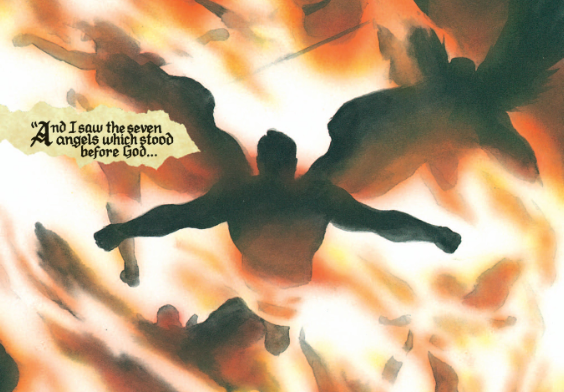
We open with another of Wesley’s visions. Shadows of heroes soar through the flames of Lady Liberty’s torch, once again heralded by lines from the Book of Revelation: “And I saw the seven angels which stood before God…”
Looking down over the Statue of Liberty, boats and helicopters circle the crumbling structure. Americommando, bedecked in a blue jumpsuit with a red and white striped cape and a gilded eagle across his chest, declares this to be HIS country to an alarmed throng of newly arrived immigrants. As he brandishes what looks to be a machine gun hand, he berates the crowd. He and his Minutemen have defended this country from foreign threats, and now they declare war on those they deem to be the most “insidious menace” of all: immigrants. Families with frightened children scramble for cover as Americommando is engaged (mid-monologue) by another group of robotic vigilantes dressed in red, white, and blue, who claim that this is THEIR land to defend.
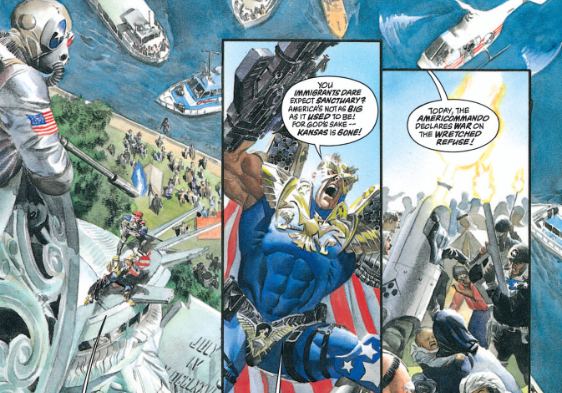
As projectiles and flames perforate the crowd, onlookers are trapped in the crosshairs. The robots claim they are here to defend, Americommando and the Minutemen claim they are here to protect, yet once again, neither show any interest in the human lives caught in their warpath. A horrified Wesley watches from above and exclaims that someone should do something, and like a bolt from heaven, the reunited Justice League descends.
They make quick work of the star-spangled instigators. Superman rips Americommando right out of his suit, while Green Lantern and the others rescue the civilians that have fallen into the water and provide cover. For a moment, Wesley calls them “angels,” agents of a higher power of righteousness and good, but as he watches the speed and strength with which they neutralize threats, he corrects himself. Not angels…
Gods.
As a reader, you can’t help but feel the weight of that distinction. These individuals carry out their own will, defend their own ideals; and while the return of the Justice League is a welcome sight, the concept of such immense power at the hands of flawed individuals is disconcerting. After all, Americommando and his Minutemen use their power by the same self-appointed authority.
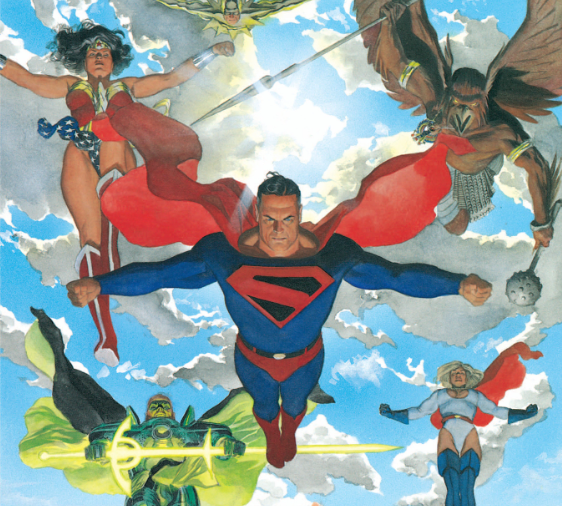
High above the havoc, two beings in metal suits panic as they realize their mental link with the patriotically adorned robots has been disrupted. For reasons yet unknown to us readers, the Brain Trust seem to have orchestrated the fight to serve their own ends. While they try to reestablish the link, Red Robin, better known as Dick Grayson, knocks them unconscious. Though seemingly inconsequential, this is our first hint that not all of the metahuman chaos is random anarchy. Some attacks are calculated, planned by unseen hands to serve some clandestine end. The fight ends with Wonder Woman saving panicked bystanders from the falling arm of the Statue of Liberty, just in time for the press to arrive with a slew of questions, chief among those: “Where have you been?”
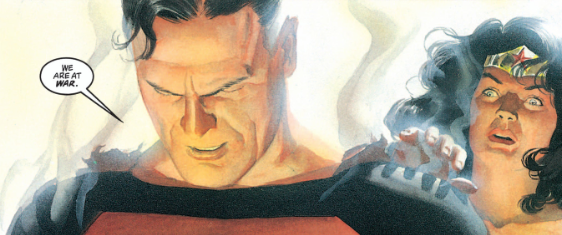
To get ahead of speculation, Superman holds a press conference at the United Nations. He declares that it was a mistake for the Justice League to step down and vows that he and his counterparts will teach these new metahumans “the meaning of truth and justice.” He promises that, guided by wisdom, order will be restored, but chillingly clarifies these ends will be met “if necessary, with force.” Superman’s stated aim is to “make things right again,” but his plan to do so is vague at best, and once again seems to leave law and order up to the discretion of vigilantes. Reporters begin to question what will happen if Magog resurfaces, and more importantly, what is to be done with metahumans who do not abide by the Justice League’s principles? With a wave of her hand and a quick “that is all,” Wonder Woman ends the press conference, and the heroes depart.
The leaders of the U.N. are less than thrilled with Superman’s return. These government officials are not in control of humanity’s path forward, and Superman’s resurgence — his determination of next steps without consulting any sort of political or legal body — does not bode well for the hand ordinary humans will have in the events to come. There is a flaw in the Justice League’s principles. While they have the power to act, they are not elected officials, nor judges, nor lawyers, nor appointed law enforcement. They have the power, but not the authority. Superman may show far more deference to the legal process than the new generation, but in his absence, the world has come to terms with the fact that such deference was, at best, a thin veneer that could be broken at will with little recourse. He may intend for his words to reassure the public, but for those reading between the lines, it is yet another metahuman using their power to take control. Wesley is still relieved at Superman’s return, though knowing that his role is to judge some coming evil in which Superman is entwined, he is becoming increasingly anxious about what all of these visions mean.
Next, we arrive at Wayne Manor, or to be more specific, the crumbled and seemingly abandoned remains of Wayne Manor. Superman knows better, of course. He descends into the waterlogged Bat-Cave in search of Bruce, who greets him with his trademark unimpressed snark. Bruce Wayne is exactly where we’d expect to see him — alone in the dark, surrounded by tech and glaring down a wall of screens showing live images of Gotham. He dismissively reveals that Bane and Two-Face destroyed the manor when his identity was leaked, but the desecrated upper floors are of little consequence to him. The tension between Bruce and Don’t-Call-Me-Clark is clear while the latter mentions that Arkham, Belle Reve, and Blackgate were all blown up by a metahuman, destroying not only the prisons, but most of the prisoners and personnel within. Despite the utter annihilation of most of his core villains, Bruce seems to be keeping busy, which is his response when Superman asks him to rejoin the Justice League.
Predictably, Bruce has a different perspective on the crisis they’re facing than Superman. While remotely controlling a bat-eared robot as it confronts a robber, he states that metahuman numbers have grown exponentially, and those with superpowers are now in primary control of the world. The situation requires “finesse and meticulous, careful planning,” which he does not see the Justice League’s “punch now, ask questions later” approach conducive to. Superman retorts that while Bruce may think his new Gotham a utopia, it is nothing more than a police state in which Bruce uses constant surveillance and robotic agents to confront criminals, creating a perpetual state of fear and paranoia among Gotham’s citizens. Bruce in unphased, pointing out that his network actually goes beyond Gotham and into Star City. Furthermore, he has his own network of allies who he claims are more in tune with humanity’s needs. He dismisses Superman and the League as “totalitarian,” seemingly ignorant of the problematic nature of a privately operated surveillance state.
When Superman departs, Bruce’s hidden allies reveal themselves, though they suspect the Kryptonian knew of their presence all along. Dinah Lance, Oliver Queen, and Ted Kord (Black Canary, Green Arrow, and Blue Beetle, respectively) are among the heroes who have aligned with Bruce. They agree that Superman and the Justice League will cause more harm than good, and reveal that they have a contingency plan involving a metahuman team of their own. Wesley and the Spectre watch on, with Wesley questioning whether or not Superman and Batman were ever friends. The answer, it seems, is complicated. Not friends, perhaps, but unlikely equals.
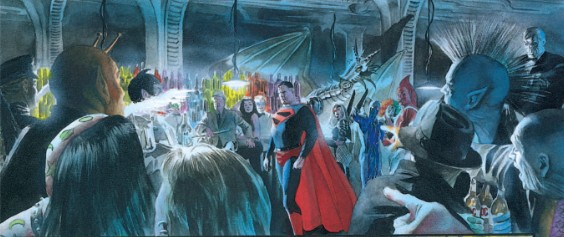
As days pass, Superman and the Justice League do what they can to resolve conflicts and mitigate damage, negotiating peaceful terms whenever possible and using force when agreements cannot be struck. They go as far as infiltrating a metahuman night club and, after needlessly destroying the bar, encourage all present to join the League, leaving an implied “or else…” hanging in the air.
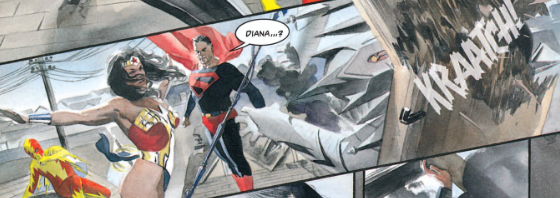
The League’s reach extends far beyond The United States, and while many seem hopeful, Wesley notes that there is something militant in the way they’ve begun to operate. Wonder Woman in particular seems to have reached a breaking point. When a new metahuman offers unwanted assistance during a fight, Diana hurls them through the sky in a rage. Superman does what he can to calm her down, but it’s painfully clear that the immortal princess has had enough of watching untrained nobodies play at war and is tired of endlessly cleaning up messes. While Superman agrees with her that these new metahumans are a problem, his mention of the sacred nature of human life comes across as nearly a rebuke. The budding fracture in their friendship is quiet here, but it won’t go away anytime soon.
If you’ve been wondering what’s become of the other supervillains since the metahuman boom, rest assured that Lex Luthor is alive and well. His “Mankind Liberation Front” is a coalition of former supervillains who believe they can use the escalating metahuman conflict for their own gain. They seem to be pouring their efforts into relief for the victims of the Kansas disaster, but as always, Luthor’s surface-level altruism only provides cover for hidden motives. In the chaos of Superman’s departure, Luthor found an opportunity to expand his reach. It’s revealed that his cohort have taken the metahuman survivors of Arkham and Belle Reve, renamed them, and outfitted them as new “superheroes.” While they are only responsible for 8% of the new vigilantes, that 8% is successfully escalating problems and further eroding the public trust in superheroes. Some of the Liberation Front are uneasy with the idea of arming more metahumans, but Luthor insists that the risk is worth the reward if it pushes humanity to rise up against all superheroes and oust them completely. The resurgence of the Justice League is an unexpected obstacle, but Luthor already has a solution in the works, and its name is Billy Batson.
Rejoining Superman and Wonder Woman, we jump to the near future. America has managed to crawl its way back from the brink of collapse, though the situation remains delicate, and the League has shifted their attention to metahuman troubles abroad. While many are so awestruck by Superman that they yield immediately, others do not, and each time a confrontation escalates to violence, Superman becomes more aggravated. His lack of true diplomatic training is becoming a liability. He attempts to make alliances with Arthur Curry, formerly Aquaman, and Orion, now in control of Apokolips, to no avail. As he and Wonder Woman argue over the increasingly totalitarian methods they’ve been forced to employ, they are interrupted by word that Magog has finally been found, and at last, it seems we’ll get more insight into the events that caused Superman to walk away all those years ago.
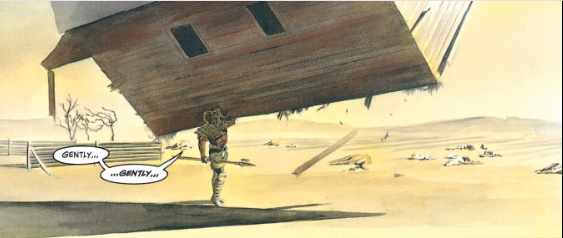
Magog is found in the barren carcass of what once was Kansas, trying, somewhat comically, to rebuild. Superman comes in, guns of moral superiority blazing, but Magog is unphased. Superman won’t hurt him, he’s sure of that. In fact, that certainty is exactly why Magog blames Superman for everything that has happened. A flashback reveals that ten years earlier, after the Joker killed the staff of the Daily Planet, including Superman’s wife, Lois Lane, Magog murdered Joker in the street. Despite the devastation of losing his wife, Superman was determined to follow the law and believed Magog had no right to act as judge, jury, and executioner. He brought Magog in to be tried, and he was acquitted. Following the acquittal, public sentiment fell behind Magog, who many believed had the guts to do what needed to be done when Superman was willing to surrender an unstable murderer back into a system from which he had escaped time and time again. Rather than have the debate and stand on his principles, Superman simply turned his back on the world, leaving humanity wide open for domination by those who idolized Magog. Magog claims that Superman left out of fear of the future he represented. Gesturing to the wasteland around him, he concedes that this is the future he represents before attacking Superman.
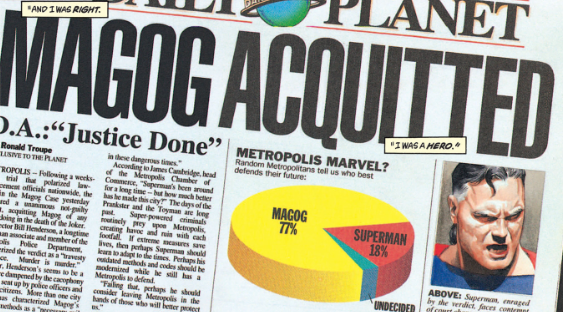
When the smoke clears, Magog is a broken man and Superman is left standing. He begs Superman to kill him and take away the million ghosts that haunt him for his choices, which brings Superman to consider what should be done with the metahumans who won’t fall in line and the ones who have crossed lines that cannot be forgiven. The answer: Big prison. Not a bad idea at its core, but once again, a prison controlled by the Justice League is one that bypasses much of the standard protocol for arrest and sentencing, effectively removing any agency in the metahuman situation from ordinary humans. Wesley points out something that might be even more problematic: containing all of the presumed violent metahumans under one roof is concentrating an awful lot of volatile power in one place, or as you might call it, creating a ticking time bomb.
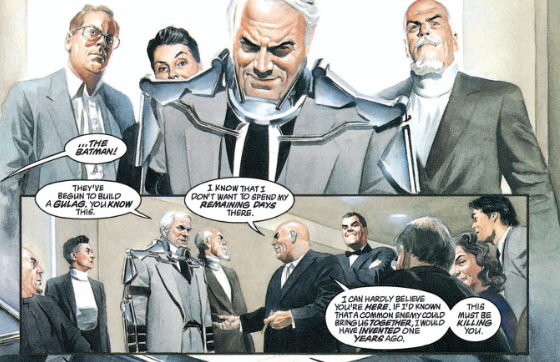
Chapter two closes with the beginning of an unthinkable alliance: Bruce Wayne and Lex Luthor. Bruce has become aware of the Justice League’s new super-prison and feels he has tolerated all he can. Against all expectation, Bruce’s disdain for Superman’s methods appears to outweigh decades of bad blood between himself and the villains that now work with Luthor, many of whom were once part of his own rogues gallery such as Catwoman (Selina Kyle) and The Riddler (Edward Nigma). In constructing a prison where the Justice League can jail perceived threats at their own discretion, Superman has inadvertently made the League judge and jury over the rest of the world. Bruce isn’t about to wait and see if the liberties they take will extend to becoming executioner too, and thus the alliance of our collective nightmares is born.
Final Thoughts
Despite the Justice League’s best intentions, there’s something unsettling in watching them operate without any substantial input from government or law officials. Though they may be trying to help, they’ve seized the reins of society without the authority to do so, thus stripping ordinary humans of our already flimsy power to influence world events by who we vote in and out of office. Superman makes it clear that he and the Justice League will decide what happens to the rogue metahumans and voices no intention of including actual lawmakers in those decisions. On the flip side, Bruce Wayne crafts his Gotham utopia using high-tech surveillance, crowd control, and fear — certainly without any safeguards to protect people’s information, ensure that their rights are respected, and regulate what information Bruce can act upon.
As readers, we naturally want to trust Batman, Superman, and Wonder Woman, yet their proposed solutions to a problem they helped to create are nightmarish and riddled with moral failings. In chapter one, we see Superman’s return as a reprieve from chaos, a return to the well-meaning and orderly vigilantism we know and love, but by the conclusion of chapter two, readers are forced to confront how our heroes’ interpretation of their own authority only extends, and is likely the genesis of, the chaos we hope they’ll protect us from. It’s said that in chaos lies opportunity, and in the chaos of a world overrun with metahumans, different factions have seized the opportunity to offer their own solutions, each of which will wrest power away from the many and reallocate it to an untouchable few.
My reaction to Bruce’s method of establishing order in Gotham is quite different this time around than it was years ago. I suppose in 2017, being constantly monitored by tech companies and left at the mercy of billionaires who obtain personal information without consent still felt like fiction, fiction that was possible and sneaking up on the periphery, sure, but not an imminent crisis. I certainly wouldn’t have guessed that one of those billionaires (appointed, not elected, mind you) could be placed in the center of the American government and given free reign to scrutinize our private information without any question of whether such access could be a conflict of interest. I was delightfully ignorant of how quickly tech companies could compile everything from our facial structures and fingerprints, to frequently visited locations and search history, effectively mapping out our lives in the interest of profit. In the interest of profit at best. At worst… In recent years, government interest in utilizing these violations feels especially concerning. Privacy always felt like a basic right, and our government defends those rights… yes? Furthermore, with the overwhelming push by large corporations to accept AI as an indispensable piece of daily life, it might be foolish to think it impossible that we won’t see a future where law enforcement is reduced to remotely controlled (or artificially controlled) robots. I don’t want to imagine that future, but I’m certainly not going to ignore the same warning twice.
Prophetic as ever, Mark Waid and Alex Ross wove this question of technological cohesion into the landscape of Kingdom Come. Not only are we questioning the lawless chaos of the new metahumans and The Justice League’s self-appointed authority, but now we ponder the cost of order when it strips individuals of their basic rights under the guise of protection. Bruce questions Superman’s authority, but what of his own? What gives him the right to spy on Gotham’s citizens and round up criminals while remaining aloof and untouchable? He’s willing to let the people of Gotham exist in a state of fear if it guarantees their safety, but why should he get to make that decision on their behalf?
One of the fascinating things Kingdom Come does is force us to dissect the reality of a world in which superheroes define right and wrong, confront criminals, and dole out punishment. On the surface, we rarely question the morality of the Justice League when they’re battling alien invasions and wild-eyed super villains. We don’t question Superman when he throws himself between a young family and a burglar’s bullet and whisks the would-be murderer off to prison. We believe in their inherent good because they are our heroes, their moral superiority is implied. But what happens when the prevalence of vigilantes outranks the reach and effectiveness of trained law enforcement, and decisions impacting the world’s future are made not by elected governments which adhere to constitutional checks and balances, but by individuals that happen to be able to fly or have wealth enough to bypass typical limitations? The tiny cracks building in the relationship between Wonder Woman and Superman are reason enough to question how much control they should have. Both are respected heroes of the old generation, both have a track record of doing the right thing and serving others, but by the end of this second chapter, their values are beginning to diverge, and the chasm forming places any balance they’ve restored on shaky ground. When the safety and well being of humanity is placed in the hands of individuals who believe themselves above the law, or worse, believe themselves to be the law, the path forward cannot help but be tragically unstable and fraught with injustice.
Image credit: DC Comics